Six-Card Golf
Six-Card Golf uses a 2×3 layout with matching vertical pairs worth zero. Twos are −2 in the cited base game; record the hand after one layout becomes fully visible.
Named rules reference · Lowest total wins
Start scoring Six-Card GolfSix-Card Golf tutorial — joker variant
Learn the deal, draw-and-replace turns, final turns and scoring in this six-card Golf variant, with a separately labeled optional flip-only house rule.
Video variant. This tutorial uses twos +2, jokers −2 each and a vertical joker pair −4. Other matching vertical pairs score 0. Each player flips two cards on their first turn, then draws. When one player exposes all six cards, everyone else gets one final turn. The optional later-turn flip-only rule is a separate house rule: flip one hidden card instead of drawing; that uses the whole turn.
The written reference below describes Pagat’s base game: twos −2, equal vertical pairs 0 and an immediately ending hand. Choose one complete variant before play. The scorekeeper accepts your manually calculated totals for either variant.
Video loads when you choose Play or a chapter. Spoken narration is captioned in the picture; selectable English captions and a text transcript are also available.
Open MP4 (14.4 MB) · English captions (WebVTT)
Read the full tutorial transcript
Welcome to six card Golf. Keep your total low over nine holes.
For two to four players, shuffle one deck with two jokers.
Add another deck for a larger group.
Deal six cards face down to each player. Keep them hidden.
Arrange them in two rows of three. Each vertical pair is a column.
The remaining cards form the stock.
Turn its top card face up to start the discard pile.
The player left of the dealer starts. Play moves clockwise.
On your first turn of each hole, start with two reveals.
Flip these two cards face up: a seven and a two.
Then draw. Here, take a king from the stock.
Choose this hidden card to replace. Commit before looking at it.
Replace it with the king, and discard the hidden queen.
Now three cards are face up.
The two card opening happens only on your first turn.
On later turns in the reference rules,
draw from the stock or take the top discard.
Here, another player has discarded a seven.
Take that seven and replace your visible nine.
Discard the nine. The two sevens now share a column.
A matching column scores zero.
You must use a card taken from the discard pile.
A stock draw gives you another choice.
Draw this ten. You can replace a layout card, or reject the draw.
Discard the ten. That ends this turn, with the hidden cards still hidden.
There is no automatic extra flip after rejecting a stock card.
You may replace a face up card or a hidden card.
Choose a hidden position before you see its value.
Once chosen, that old card goes to the discard pile,
even if you would have preferred to keep it.
If the stock runs out,
keep the top discard available and shuffle the rest into a new stock.
When one player exposes all six cards, that player is finished.
Each other player gets one final turn.
After those turns, reveal any remaining hidden cards. Then score every layout.
Record the hole, deal again, and compare cumulative totals after nine holes.
Here is the separately agreed house rule option:
on later turns, draw, or flip one hidden card.
Choose the flip option. Turn this hidden four face up.
That single flip uses the whole turn. Do not draw as well.
Your first turn still begins by flipping two cards,
then drawing. Agree on this option before play.
Score the cards left in your layout at the end of each hole.
A joker scores minus two. A king scores zero. An ace scores one.
Twos through tens score face value. A two is plus two.
Jacks and queens each score ten.
Equal ranks in one column cancel to zero,
with one exception: two jokers together score minus four.
Let us score this six card hand.
The two sevens match, so column one scores zero.
The joker and king total minus two.
The two and ace total three.
Zero, minus two, plus three gives a final score of one.
Now look at a hand with both jokers.
The joker column scores minus four. It does not cancel to zero.
King plus ace is one. Two plus eight is ten.
Minus four, plus one, plus ten makes seven points.
Add each hole to your running total. After nine holes, the lowest total wins.
Choose your house rules together, then enjoy the game.
Card Game Scores: less paper, more play.
How to play Six-Card Golf
Setup
- Deal six face-down cards in two rows.
- Turn two cards face up; start stock and discard piles.
Play a hand
- Draw, replace one card face up and discard the old card.
- A stock draw may be discarded; a taken discard must replace a card.
How scoring works
- A=1; 2=−2; 3–10 face value; J/Q=10; K=0.
- Equal vertical pairs score zero, including paired twos.
Game end: A fully exposed layout ends the base hand immediately. Lowest total after nine deals wins.
What this scorekeeper records
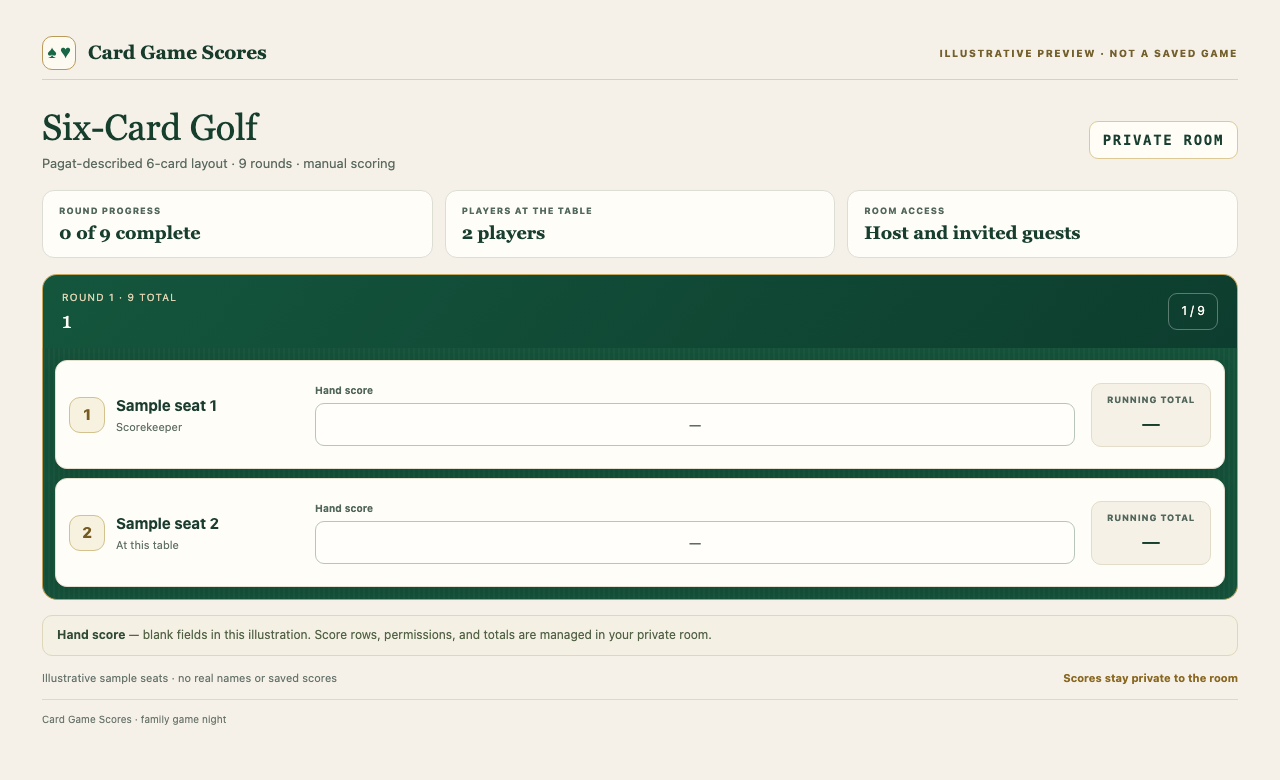
Enter each player’s final hand total. Card ranks and vertical pairs are not evaluated by the app.
Scoring example
A 2×3 layout totals 21 before pairs; one matching vertical pair cancels to 0. Enter the remaining score after applying the full table rule.
Frequently asked questions
Are twos worth two?
The cited base rules use −2; +2 with jokers is a separate variation.
Do diagonal pairs cancel?
Not in this vertical-pair version.
Does the app detect pairs?
No. Enter the adjusted layout score.
Sources and variant notes
- Pagat — Golf
Named rules reference
Rules summary reviewed 2026-10-06. Use the named edition and agree on house rules before play.
Public guide only. Score rooms, room codes, and player names are private and are not included on game pages or in the sitemap.